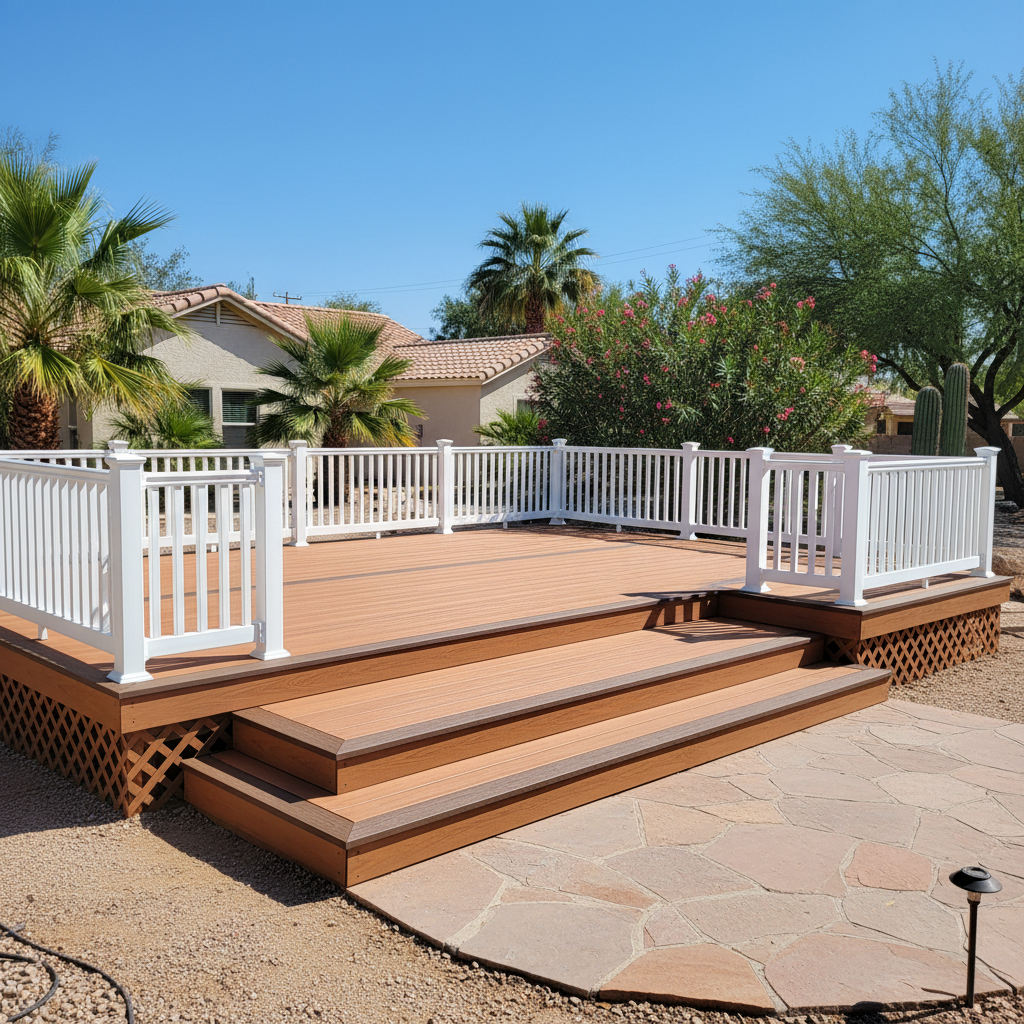
Alright, let's talk Trex decks here in Coolidge. You're probably looking at composite for a reason — less maintenance, it stands up to our brutal Arizona sun way better than wood, and frankly, it just looks sharp. But what's it actually going to cost you? I get this question all the time, and 'it depends' isn't helpful, so let's get specific.
What Makes Trex Deck Prices Go Up or Down?
A few big things push the price tag around. It's not just the size, though that's a huge part of it. Here's what I look at when I'm putting together a quote:
- Deck Size and Shape: This one's pretty obvious, right? A bigger deck means more materials and more labor. But a complex shape, like curves or multiple levels, adds even more. Every extra angle or cut takes time and specialized skill.
- Trex Product Line: Trex offers different tiers. You've got your basic Enhance line, then Select, and finally the premium Transcend and Signature lines. The higher-end stuff gives you more realistic wood grain, richer colors, and better warranties, but it costs more per linear foot. For a typical 12x20 deck, just moving from Enhance to Transcend could add $1,500 to $3,000 to the material cost alone.
- Substructure Materials: This is the framework underneath the deck. Most folks around here go with pressure-treated lumber for the joists and beams. It's durable and cost-effective. Some homeowners opt for steel framing, especially for elevated decks or if they want maximum longevity and stability. Steel costs significantly more, sometimes doubling the substructure material cost.
- Foundation Type: In Coolidge, our soil can be pretty hard-packed, but you still need solid footings. We typically use concrete piers. The depth and number depend on the deck's size and local codes. If we hit caliche, digging can take longer and cost a bit more for specialized equipment.
- Railing System: This is a big one. Basic pressure-treated wood railings are the cheapest. Composite railings from Trex (like their Transcend or Signature lines) look great and match the deck, but they're pricier. Aluminum railings are another popular, low-maintenance option that falls somewhere in the middle. Glass panel railings? Those are top-tier and will add a significant chunk to the total.
- Permits and Design: Don't skip this step. Any deck over a certain height or size in Coolidge will need a permit. That means plans, inspections, and fees. A good contractor handles this, but it's part of the overall cost. Complex designs might also require engineering stamps, which adds to the upfront design cost.
- Site Accessibility: Can we easily get materials and equipment to your backyard? If we have to hand-carry everything through a narrow gate or over landscaping, that adds labor time.
- Extra Features: Built-in benches, planters, pergolas, custom lighting, staircases (especially curved ones), or even an outdoor kitchen integration — these are all add-ons that bump up the price.
Typical Cost Ranges for Trex Decks in Coolidge
Okay, let's get to some numbers. Based on what I've seen and built for folks in neighborhoods from Mission Royale to Robson Ranch, you're generally looking at:
- Basic Trex Deck (Enhance line, simple design, wood railing): For a ground-level 10x12 deck, you might be in the range of $6,000 - $9,000. A 12x20 could be $10,000 - $15,000. This is for a straightforward, functional deck.
- Mid-Range Trex Deck (Select or Transcend line, composite railing, maybe one set of stairs): A 12x20 deck in this category could run you $15,000 - $22,000. A larger 16x24 elevated deck might be $25,000 - $35,000. This is where most people land, getting a great balance of looks and durability.
- Premium Trex Deck (Transcend or Signature line, premium railing, multiple levels, lighting, custom features): For a larger, custom-designed deck, say 20x30 with all the bells and whistles, you could be looking at $35,000 - $60,000+. These are the showstopper decks, truly.
These are rough estimates, of course. Every project is unique.
What Should Be in Your Trex Deck Quote?
When you get a quote from Coolidge Deck Builders (or anyone else), make sure it's detailed. It should clearly break down:
- Materials: Specific Trex line, quantity of decking, substructure lumber (e.g., pressure-treated 2x10s), fasteners, concrete, railing components.
- Labor: Itemized for framing, decking installation, railing installation, stairs, etc.
- Permit Fees: Usually listed as a separate line item.
- Site Prep/Cleanup: What's included for clearing the area and hauling away debris.
- Warranty Information: Both for the materials (Trex has great warranties) and the contractor's workmanship.
- Payment Schedule: How and when payments are due.
How to Avoid Overpaying for Your Trex Deck
Nobody wants to get ripped off, especially not on a big investment like a deck. Here's my advice:
- Get Multiple Quotes: This is fundamental. Talk to at least three reputable local contractors. Don't just go for the cheapest; compare what's included in each quote.
- Be Specific About Your Vision: The more details you can give us upfront, the more accurate our quote will be. Show us pictures, tell us exactly what you want.
- Understand the Trex Lines: Know the difference between Enhance, Select, and Transcend. Don't pay for Transcend if Enhance meets your needs.
- Ask About the Substructure: A cheap quote might be cutting corners on the framing. Make sure it's robust and built to code.
- Check References and Licenses: Always, always, always. See their past work. Call their references. Verify they're licensed and insured in Arizona.
- Don't Be Afraid to Ask Questions: If something in the quote doesn't make sense, ask. A good contractor will be happy to explain it.
A Trex deck is a fantastic addition to any Coolidge home, giving you a beautiful, low-maintenance outdoor living space that can handle our intense summers. Do your homework, get solid quotes, and you'll end up with a deck you'll enjoy for decades.